triapet.com
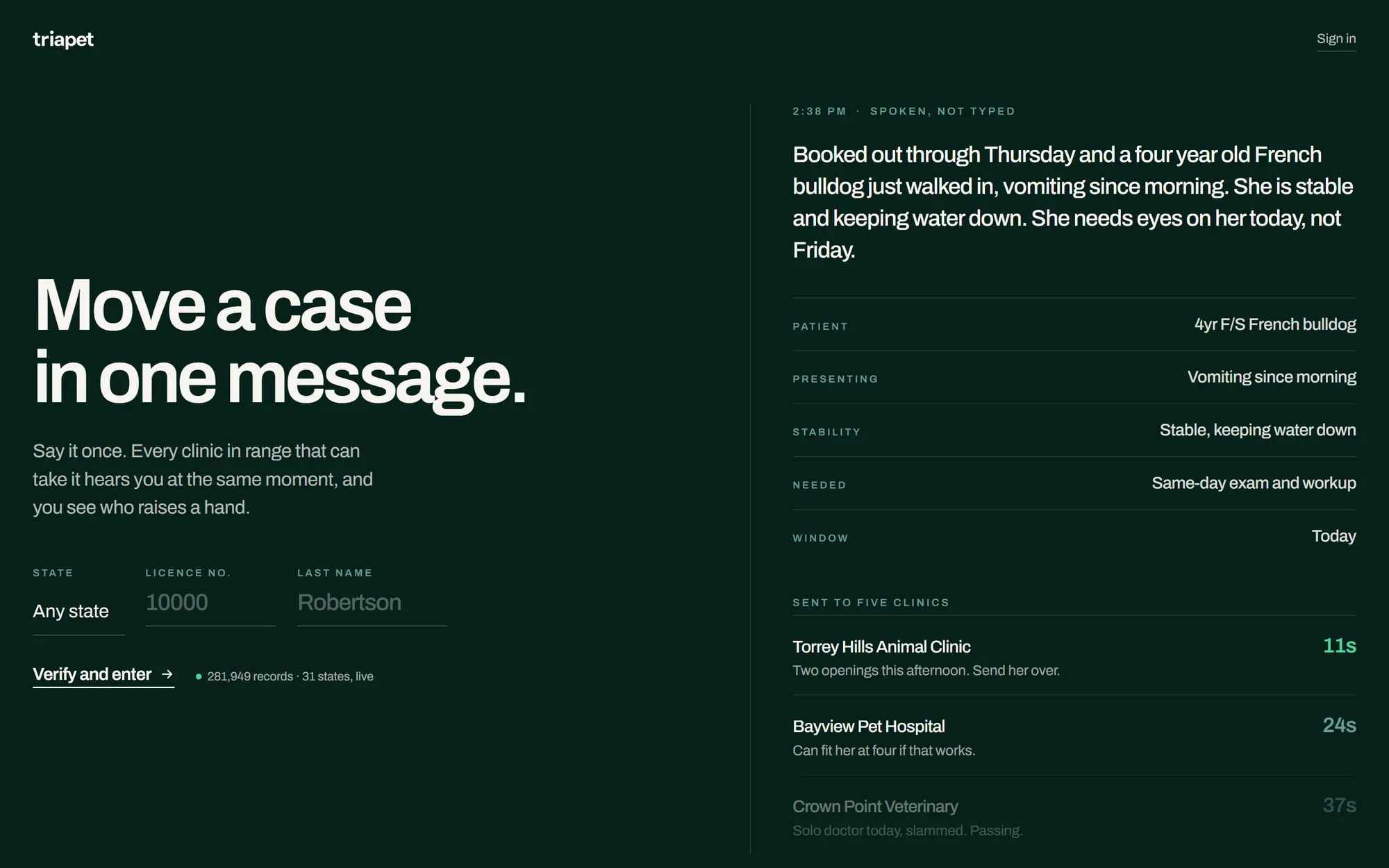
Veterinary care marketplace
A stalled MVP became an AI referral platform.
281,949 veterinary board records across 30 states and DC behind the clinician verification gate
Venture we operateTriaPet
Read the case →Industries · Telehealth
We built telehealth for private doctors’ offices: online booking, a symptom check before the visit and secure video visits for human patients. We also run a care marketplace with triage, clinic routing and a mobile app on one API. Its patients are pets; the engineering is the same.
30 minutes. A written gap map. No pitch unless you ask for one.
281,949
veterinary board records across 30 states and DC behind the clinician verification gate
SOURCE · TriaPet license index, as served by the live counter on triapet.com
METHOD · Row count of the verification index across 31 veterinary licensing boards (30 states plus DC), read from the live counter on 2026-09-28. It counts every credential the boards publish (technicians, clinic premises, permits and lapsed licenses included), not only active veterinarians.
VERIFIED · 2026-09
CLASS · platform account
✓ every number on this site opens its receipt
CLAIM · license-records
How we count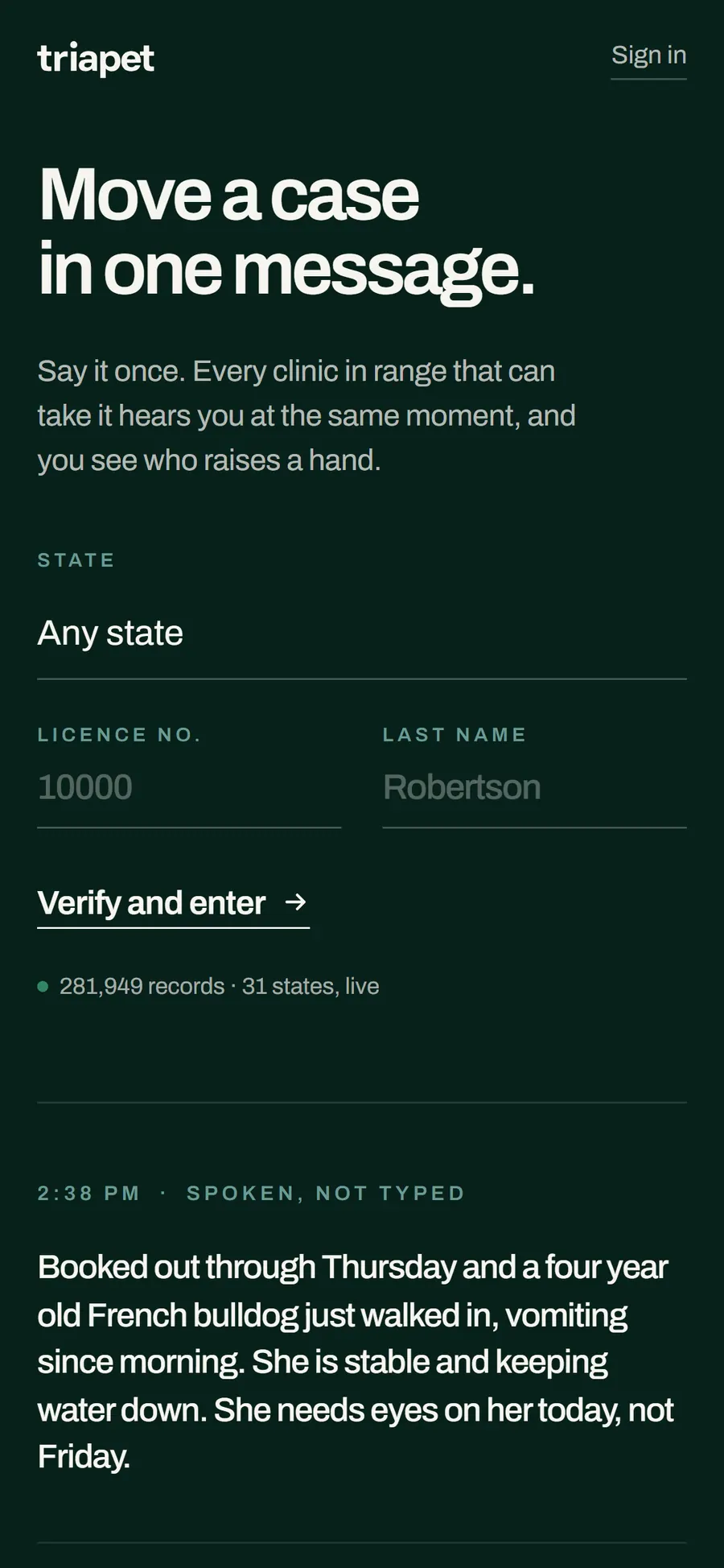
01 · What goes wrong
The problems telehealth and care-marketplace founders bring us, in their words. One is enough to start asking questions.
A prompt can score a symptom. It cannot notify a clinic, verify a clinician, bill a visit or tell you where patients give up. The demo impresses investors and stalls at the first real user.
Referrals sit in an inbox until someone refreshes it. Urgent cases wait in the same line as routine ones, and the patient goes somewhere else.
Marketplaces grow on supply, so the signup gate stays open. One unverified provider is a liability the whole network wears.
Front desk, clinician, billing and support all see everything, because roles were a later phase. The first question from a partner’s security review has no answer.
Confirmations, invoices and re-engagement texts are sent from a spreadsheet or a tool nobody checked for opt-outs. Deliverability and trust both decay.
02 · What we build
Intake, routing, the clinician network, access control, billing and an app built for both stores, because a care product fails in the gaps between them.
01Triage
A guided intake wizard, urgency scoring with a dedicated path for emergencies, and referrals broadcast to nearby clinics or sent direct to one, with a status the patient can watch change. The model scores; the server decides.
02Visits
Virtual appointment booking, a symptom assessment before the visit and secure video consultations, the way we built them for private doctors’ offices.
03Network
Providers claim their license against the state board roll and pass an SMS possession check before they can take a case; the network is in pre-launch. Clinic onboarding is modeled as a lifecycle, from lead through pilot to live and at-risk.
04Access
Separate roles for admin and clinic staff, documented in the repo, audit trails for sensitive actions, and a consent ledger behind every email, SMS and call attempt.
Launch Engineering05Billing
Stripe webhooks drive an invoice lifecycle from draft to sent to paid or overdue, modeled in the schema so finance can see every state, on the same Stripe rails that handle refunds on our other platforms.
06Mobile
Patient portal, clinic dashboard and internal admin over one API, plus an Expo app for iOS and Android built to go through App Store and Play Store review. One backend, one set of rules, every surface.
Mobile app developmentMeasurement ships with every build: conversions recorded by the API, identity stitched from the first anonymous visit to signup, and a funnel report honest enough to set the roadmap.
03 · Proof you can check
The marketplace figures are from TriaPet, a venture we operate, and are labeled as ours. E-Health Checkup, telehealth we built for private doctors’ offices, has no figures to publish. SkillSchedule is coaching, not care, but it is the same shape: booking between two sides, live video, billing and an app built for both stores. Every figure opens its receipt.
0 → 5
key conversion events live and linked to Google Ads, on a launch that began with an empty tag container
SOURCE · Analytics property change log for a marketplace we operate
METHOD · Key events and the Google Ads link created in the analytics property, read from the property’s change log.
VERIFIED · 2026-09
CLASS · platform account
✓ every number on this site opens its receipt
CLAIM · key-events-zero
How we count~25
consent-aware lifecycle email events on one product, alongside Twilio SMS
Booking confirmed or rescheduled, invoice sent, paid or overdue, re-engagement, review requests.
SOURCE · TriaPet platform repository (Klaviyo event catalog)
METHOD · Count of distinct lifecycle events wired to Klaviyo with consent checks.
VERIFIED · 2026-09
CLASS · repository
✓ every number on this site opens its receipt
CLAIM · lifecycle-events
How we count67%
of clinic-picker views showed no nearby clinic in our first 30-day report
78 real users; the first triage question lost 73% of viewers. Clinic coverage and question one became the roadmap.
SOURCE · TriaPet Mixpanel funnel report (30 days)
METHOD · Server-authoritative events with identity stitched from first visit through triage to signup.
VERIFIED · 2026-09
CLASS · platform account
✓ every number on this site opens its receipt
CLAIM · funnel-diagnosis
How we countv1.0.4
SkillSchedule’s iOS and Android app, built on Expo alongside the web portals
Expo / React Native with Stripe billing and refund splitting, sharing one API with the parent, coach and admin portals.
SOURCE · SkillSchedule mobile repository (app version and EAS build configuration)
METHOD · Version string from the app’s production build configuration.
VERIFIED · 2026-09
CLASS · repository
✓ every number on this site opens its receipt
CLAIM · app-store-live
How we count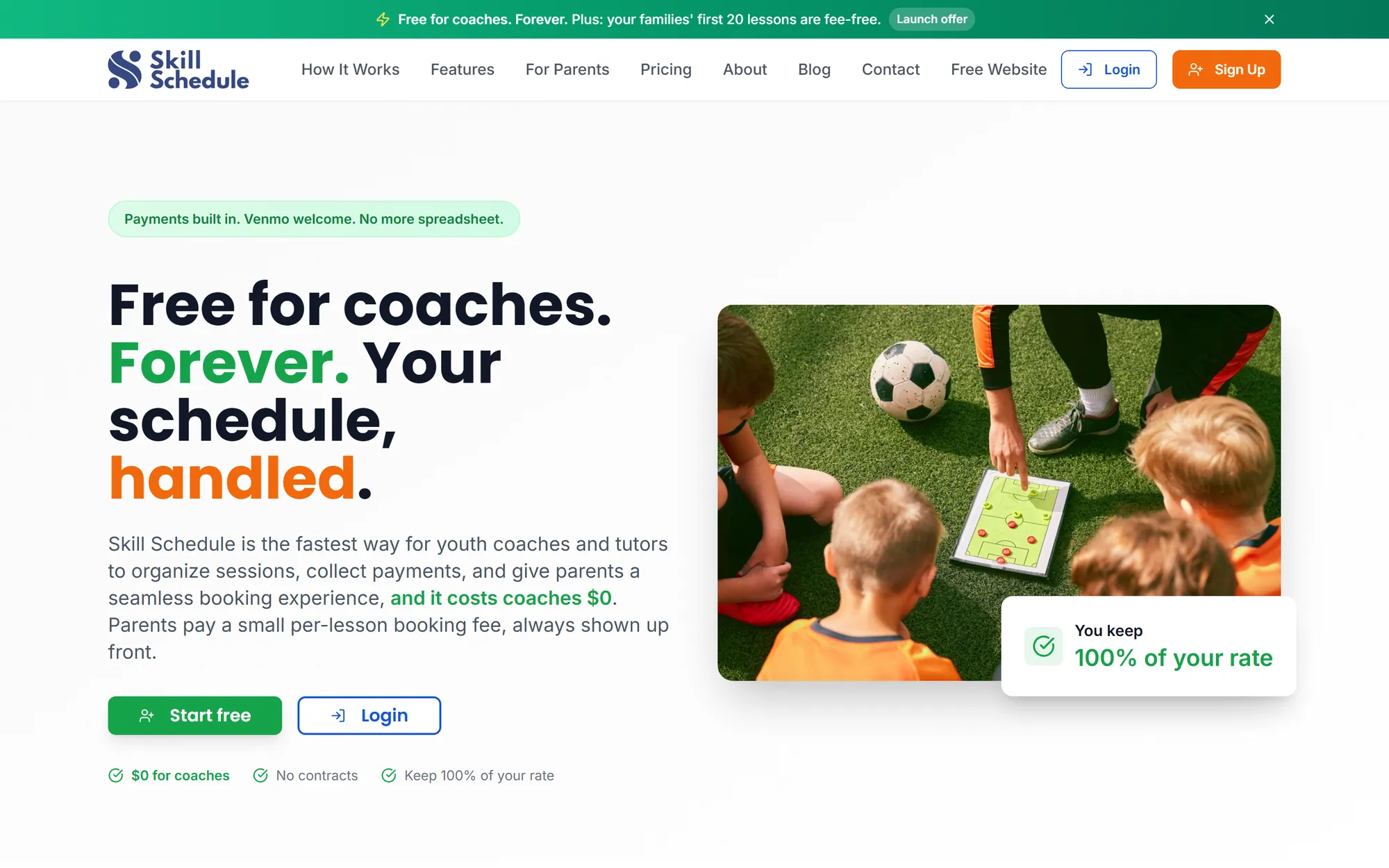

Telehealth · E-Health Checkup
Virtual appointment scheduling, pre-visit symptom assessment and secure video consultations for human patients, built for a physician-founder’s private medical offices.
04 · How it starts
The same order every time, because each step protects the next. You see the plan before we start and the product before a patient does.
Every line of code we ship runs on one rule: AI drafts, senior engineers decide. How we build →
Bring the triage prototype, the booking flow you started, or just the clinic relationships. We walk it together, then hand you a written gap map across hosting, access control, consent, billing, clinic notifications, app stores and measurement.
Out a written gap map, yours to keep
If there is a fit, you get a fixed price and a written plan: what we keep, what we rebuild, and why. If there isn’t a fit, we say so.
Out fixed price + written plan
Roles for every kind of staff member, audit trails on sensitive actions and the consent ledger go in before any feature moves, so everything that touches a patient lands on something you can explain.
Out roles and consent under test
The intake wizard, urgency scoring with the server deciding what happens next, live referral routing, and a clinic dashboard that makes a referral impossible to miss. Clinician verification gates the network.
Out referrals reach a clinic, live
Per-visit invoicing on Stripe webhooks, then a monitored cutover with a rollback path. The Expo app goes through App Store and Play Store review as part of launch, not after it.
Out built for both stores, monitored
A written tracking plan with conversions recorded by the API, so the first funnel report says where patients give up. Then the Growth Engine: lifecycle email and SMS with consent checks, and paid traffic judged on bookings.
Out a next step, not a hand-off
05 · Straight answers
Both, and we are plain about which is which. We built E-Health Checkup, telehealth for private doctors’ offices treating human patients: scheduling, pre-visit assessment and secure video. The platform we run day to day is a veterinary care marketplace, which is where our live figures come from.
The parts that make telehealth hard are the same on both sides of the species line: routing, verification, access control, consent, billing and measurement.
Usually, yes, and the prototype is the spec. Our own marketplace arrived as a hand-off MVP with one prompt doing triage and the symptom flows in JSON. We kept the flows and the product decisions and rebuilt what production demanded. The gap map says what stays and what goes before a line changes.
As engineering, not as a badge. Separate roles for each kind of staff member, documented in the repo. A consent record behind every email, SMS and call. Audit trails on sensitive actions and one-click unsubscribe, as on our other platforms.
If your counsel or a hospital partner has a specific list of controls, bring it to the review. We map it line by line and say plainly which ones we have built before and which we have not.
Only with the server in charge. The model scores urgency; the platform decides what happens next, routes the referral and keeps the record. Emergencies get their own path. For voice, the agent has a tested disclosure boundary and is graded against a written rubric before it touches a real front desk. It is a feature with guardrails, not the product.
Yes. Telehealth app development is part of the build: patient portal, clinic dashboard and admin share one API, and the Expo app for iOS and Android sits on the same API, so a rule changes once and holds everywhere. Store submission is part of launching, not a separate line item.
Yes, and the clinic side is where most care products stall. Clinic onboarding is modeled as a lifecycle, from lead through pilot to live and at-risk, the clinic dashboard makes a referral impossible to miss, and the first funnel report says where patients give up between triage and the clinic. Bring the relationships to the review and the gap map starts from them.
06 · The front door
Bring the triage prototype, the booking flow or just the clinic relationships. Leave with a written gap map across hosting, access, consent, billing, routing and the app stores, before you spend a dollar. If we’re not the right team to close the gaps, the map is still yours.
30 minutes. A written gap map. No pitch unless you ask for one.
info@synaptech.io +1 (925) 255-9507 Pleasanton, CA